Blockchain Document Integrity — SHA-256 anchoring on Base in TMSDASH
Tamper-evident record-keeping on the Base blockchain. Every new BOL, DVIR, invoice, signed document, and uploaded file gets a SHA-256 fingerprint anchored on-chain automatically, and a daily driver-GPS integrity commitment hashes each carrier's GPS activity once per morning. Only hashes go on-chain — document files, GPS coordinates, payments, and customer data always stay in TMSDASH private storage. The anchoring page tracks every anchor with verification, transaction tracking, and a testnet-to-mainnet network switch.
Overview
Tamper-evident record-keeping on the Base blockchain. Every new BOL, DVIR, invoice, signed document, and uploaded file gets a SHA-256 fingerprint anchored on-chain automatically, and a daily driver-GPS integrity commitment hashes each carrier's GPS activity once per morning. Only hashes go on-chain — document files, GPS coordinates, payments, and customer data always stay in TMSDASH private storage. The anchoring page tracks every anchor with verification, transaction tracking, and a testnet-to-mainnet network switch.
How to get there
Key features
- SHA-256 fingerprinting — each document is hashed (raw file bytes, or a sorted-key JSON snapshot for record-based documents like invoices) and the hash is recorded on-chain
- Automatic anchoring at creation — new BOLs, DVIRs, temperature logs, invoices, signed documents, and uploaded workspace/load/HR-DQ/compliance files are anchored by automated workflows with no manual step
- Daily driver-GPS integrity commitment — once each morning per carrier, the day's GPS summary is hashed and anchored, carrying only the commitment hash plus non-identifying driver and ping counts (never coordinates)
- Dual-network support — Base Sepolia (testnet, free faucet ETH) by default, Base Mainnet for permanent production evidence; anchors keep the network they were created on
- Verification — recompute the fingerprint from private storage and compare it against the recorded hash and the on-chain transaction calldata; a mismatch flags a post-anchoring edit
- Per-anchor transaction tracking — transaction hash, block number, anchored timestamp, explorer link, and retry/re-anchor actions for pending or failed submissions
- Strict privacy boundary — no document bytes, GPS coordinates, payment details, or customer data are ever written on-chain
- Idempotent commitments — one GPS commitment per carrier per day, with deduplicated anchors per network and document
- Record version history — every material change to a load, driver, vehicle, customer, or maintenance record appends a new salted version fingerprint, and a weekly batch commitment anchors the whole history so altered or omitted versions are detectable
- Evidence share links — send a read-only auditor link for any anchored document or GPS commitment, with expiry, access counts and logs, optional source-file download, and one-click revoke
- Public verification page (/verify) — anyone holding a fingerprint or evidence link can confirm it matches the on-chain record; paid verification of mainnet anchors recomputes and checks everything read-only, never signing or broadcasting a transaction
- Tamper-evidence, not truthfulness — anchoring proves a document has not changed since it was anchored; it does not certify that the content itself is accurate, and every evidence report states this explicitly
Step-by-step
- 1Open /anchoring. The network card shows the active network (Base Sepolia or Base Mainnet), the anchoring wallet address, and its ETH balance.
- 2Documents you create from now on — BOLs, DVIRs, invoices, signed documents, and uploads — are fingerprinted and anchored automatically on the active network.
- 3Review the anchor table: each row shows the document, its fingerprint, status (pending, anchored, verified, mismatch, failed), network, and transaction link.
- 4Click Verify on any anchor to recompute its fingerprint from private storage and confirm the on-chain transaction matches — verified anchors turn green, mismatches flag tampering.
- 5Check the GPS Integrity section each morning: one commitment per carrier per day, with driver and ping counts. Verify them the same way.
- 6For production-grade evidence, switch the active network to Base Mainnet (needs a funded wallet) and use re-anchor to submit existing fingerprints on-chain permanently.
- 7Need to prove a document to an auditor? Create an evidence share link from the anchor row — set an expiry, optionally allow the source-file download, and revoke it any time. Auditors can also confirm fingerprints publicly on the /verify page.
Page preview

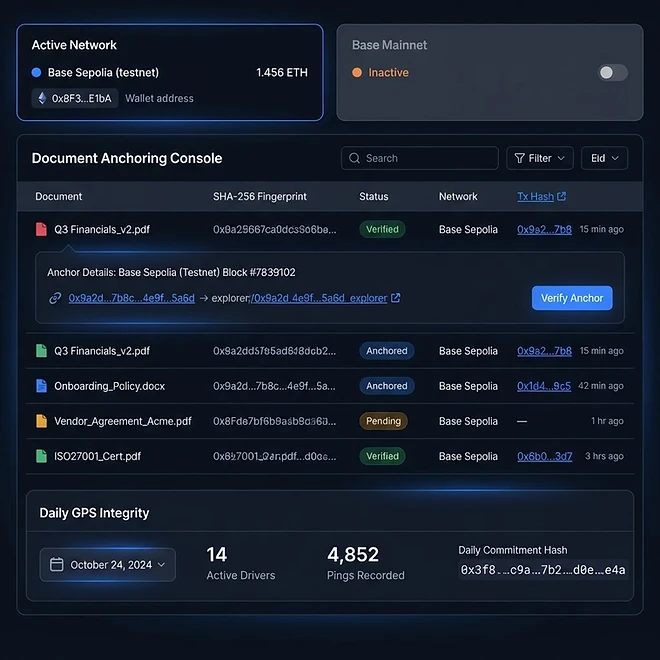
Representative screenshot of the Blockchain Document Integrity page.
Was this helpful?
Related modules
An in-app AI assistant that answers operational questions and takes real actions across your TMSDASH data — loads, drivers, customers, invoices, maintenance, compliance, fuel, documents, and marketplace postings — right from a slide-out panel. It runs a bounded tool-calling loop: reading live data, then creating or updating records as you ask, with every write ownership-verified against your workspace and every tool result sanitized before it re-enters the model.
An external portal where your brokered carriers view and claim loads. Carriers sign in with an account, a share link, or an MC+PIN — no TMSDASH seat required.
Send documents out for legally-binding e-signatures. Place signature, initial, and date fields on any PDF, route to recipients in order, and track status through viewed → signed.
Third-party load tracking on brokered freight. When you connect your Macropoint account, a live tracking status feed from the broker marketplace is surfaced right on each load detail page alongside the in-app GPS map.
Ready to put it into practice?
Start your free trial and explore this module with your own data.